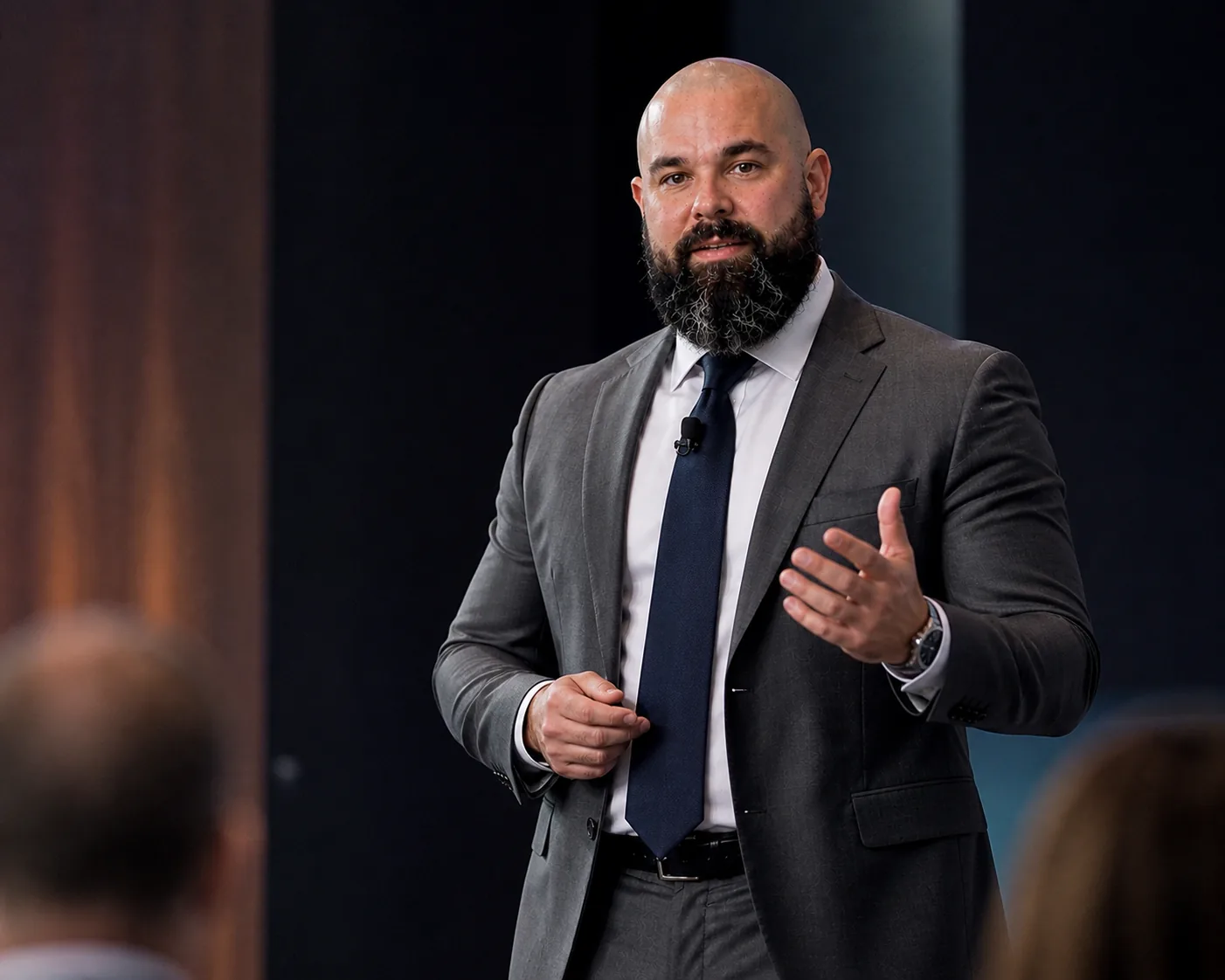
The first time I watched an accountability brief go sideways in the Navy, I was a junior analyst in a room full of senior people. Someone had gotten the intelligence wrong. The question on the table was simple: what happened. What I watched instead was an extended performance of careful language, judicious attribution, and the slow diffusion of ownership until nobody was responsible for anything in particular.
The senior officer running the debrief eventually stopped the conversation, looked at the room, and said something I have never forgotten: "Someone made a call. I need to know who it was and what they were working with." No punishment was administered in that room. But someone spoke up.
What made that possible was years of watching that officer own his own calls, including the bad ones, in full view of everyone who reported to him. The organizational math had been set slowly, through his behavior. Accountability was the rational choice because he had modeled it as something other than career-ending.
I have spent the last decade coaching senior leaders in complex organizations who are trying to create something similar. Most of them are failing, and they are failing in the same direction.
The Mandate Default
When accountability breaks down in a large organization, the institutional response is nearly universal. Leaders add more check-ins. They build dashboards. They implement OKRs with more specificity, tighten performance review cycles, and occasionally roll out a formal accountability framework with a memorable acronym. This is entirely rational behavior. It is also almost entirely ineffective at the root problem.
The assumption underneath all of it is that accountability failure is a clarity problem or a consequence problem. People do not know what is expected, or there are not real enough consequences for falling short. Add enough structure and visibility, and the behavior changes.
That assumption is wrong often enough to matter.
"Accountability cannot be mandated; it must be chosen." — Harvard Business Review, April 2026
The Math People Are Actually Doing
In most complex organizations, choosing accountability is a genuinely risky personal decision. Raising your hand when something is going sideways will cost you something. Owning a decision that later fails puts you in a position the organization rarely rewards you for accepting. Saying "we do not actually know" in a room full of people performing certainty takes a kind of courage that has to be consistently rewarded for people to keep exercising it.
Research on large executive teams suggests that accountability is measurably diluted as group size increases. In a group of ten, each member feels significant personal ownership. In a group of thirty, that ownership diffuses to the point where everyone can reasonably feel that someone else is holding it. This is not a character failing. It is a predictable structural outcome that most accountability initiatives do nothing to address.
The result is accountability theater: the visible performance of ownership, the status updates and check-ins and OKR reviews, without the underlying willingness to surface what is actually true. Leaders who have been in organizations long enough can usually feel when they are watching the theater. What they often struggle to see is that they helped build the stage.
What Theater Actually Costs
The cost of accountability theater tends to be invisible until it is not. It shows up first in decision quality: the problems that should have been raised in Q1 arrive as full crises in Q3, because the people who saw them early had already done the math and decided that surfacing them was not worth the cost. By the time the issue lands on the executive's desk, the options for responding to it have already narrowed significantly.
It shows up in executive time. An enormous proportion of senior leadership hours go into status management rather than problem-solving, because the status performance has become the primary deliverable. People optimize for looking accountable rather than being it, and they are often quite skilled at the distinction.
It shows up, eventually, in trust. When accountability is performative, the people in a team who take it seriously become a liability to the people who do not. That gap corrodes the working relationships that good execution depends on, quietly and steadily, until something external forces it into the open.
The Real Lever
The only thing that reliably changes the calculation is senior leader behavior.
People will choose accountability when the senior leader above them owns something costly and publicly, in a way that is visible enough to be credible. When a failure is met with curiosity instead of politics. When the person who surfaces a real problem early is treated differently from the person who buries one until it explodes.
None of that is structural. You cannot implement it via dashboard. What you can do is make the choice visible, repeatedly, in your own behavior, until the organizational math changes. That is a slower process than rolling out a framework, and harder to measure, which is part of why leaders default to the mandate instead.
A useful question for any executive working on this: have you made choosing accountability the rational choice for the people around you? Not through consequences, but through what they have actually observed about what happens to people who choose it.
If you are working through this and want to think through where the real leverage points are in your organization, I am happy to talk. The brief version is almost always the same: stop looking at the mandate, and start looking at the model.